Skip to content

HEADWATERS TO THE BAY

We are in a unique place:

    • When 75% of the world lives with water shortages – this College is located at one of the most important sources of fresh water on Earth…
    • When the keystone species that hold the Earth together are going extinct – we sit at the eastern gateway to one of the 36 global biodiversity hotspots…
    • When many people fear the collapse of jobs and the mass concentration of economic wealth due to exponential artificial intelligence – we are situated at the upstream headwaters – to the bay that hosts the world’s center of creative technological innovation and in many ways, its economic seat.

    This moment requires unique collaboration and reconnection, in order that humans remember and transition to a fundamental civilizational paradigm of interdependence.

abalone salmon banner 3

Headwaters: The Wisdom of Water

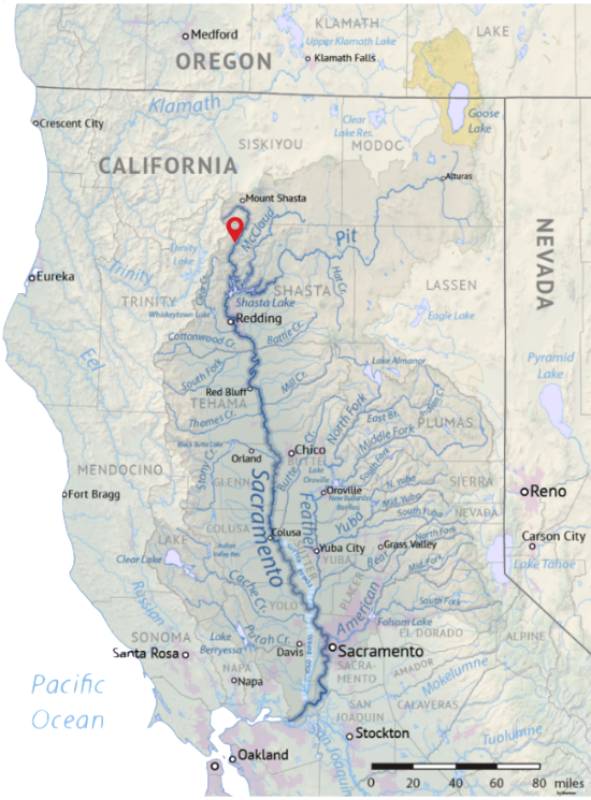
The original people called today’s Dunsmuir, “the place of strong waters”.  Mount Shasta has had the most snow ever recorded falling on Earth in a single storm. From snow packs into underground lava tubes, the vital waters here are filtered and travel fifty years or more before emerging fresh and cold from springs. These headwaters feed into one of Earth’s fifteen largest aquifer systems – the Central Valley of California, which provides North America with more than one-third of all its fruits and vegetables. 

This is all nested within a drying California, made more so because the water is dammed, preventing salmon from coming all the way home. We learn alongside the Winnemem Wintu people here who have been guardians to the wild salmon for thousands of years – supporting the salmon’s critical work to clean our rivers, and churn the gravel beds to replenish the aquifers. Chief Caleen Sisk says, “As go the salmon, so go we”, in recognition of their role as a keystone species.

At Jubilee College, we are learning again how to live in a good way: to fulfill the human’s role to honor and strengthen biodiversity… to eat from this place, to build homes, infrastructure, sanitation and energy systems – all while protecting water… to become those who care for the vulnerable, instill wisdom in our communities, build trust and forgiveness in our communities… to welcome visitors with hospitality… to be happy.

new sac river map with sf

The Bay: The Fire of Human Creativity

orange-sun-muted

The waters surrounding Mount Shasta were traditionally named by Indigenous people as “the seed of creation”, and by those who study the memory held in water, as “crystalline inspiration” (Masaru Emoto). This region begins at the headwaters, and delivers lively water into the San Francisco Bay, a place that has been a beacon for the arts, leadership of the civil rights and environmental movements, and even the birthplace of the United Nations for global peace. 
orange-sun-muted

Today it is the very center of technological creativity, and ironically, a place that now stands for western civilization’s movement towards the primacy of the rational mind, an assumption that everything is knowable, figure-out-able, and therefore controllable. Many of the gifts of creativity that are flowing downstream from Mount Shasta’s headwaters, are being used for individualistic gains, rather than offered back upstream, in gratitude, and in service to life.

Some of this may be the result of the centrality of money. Money in its current form, has more than anything else contributed to the consciousness of scarcity and separation that is reinforced with its use, every day. The listening or participation in life through the invisible, the spiritual, the embodied – the communication that flows to us from plants, water, salmon, mountains, or through the both/and perception of the heart – are secondary or absent. This is evident now in society writ large, though potent in its magnitude and density in this particular place. 

Kotaro Aoiki, of Jubilee College’s Design Team, says this has always been the case for people. Indeed, the foundation of the traditional Japanese pilgrimage is that when we have gone too far with fire, and become out of balance with water, then we have to go back upstream to pay our respects to the headwaters.

Examples of Student Research:
Exploring the role of humans in a time of AI

Many young people feel they have been guided to pursue achievements and pathways to financial success that feel hollow, and now may even be disappearing with artificial intelligence. Many are now feeling anxiety and even meaninglessness.

This context provides us the opportunity to ask, “what can humans do that computers cannot?” At Jubilee College, students learn to serve and create from their own “sound of the genuine” (Howard Thurman), in a community of others who are doing the same. Students are supported to cultivate their compassion and their passion. They are supported to cultivate an ability to listen to their “inner voice”, rather than only responding to what the outer world is telling them.

“And here is the paradox of action.

We act – not to save the world, but because it is who we are. The cellist in Sarajevo did not calculate whether his music at the site of the bombing would end the war. He played because he was a cellist, and cellists play. The fungi share carbon not because they have analyzed the forest’s needs, but because sharing is what fungi do.

This inverts everything we have been taught about purpose. We are conditioned to act in order to achieve outcomes. But the deepest actions arise from identity, not strategy. The invitation is not to “do this so that the world improves.” The invitation is “become someone for whom this action is simply natural – and trust that the larger pattern will incorporate your offering.”

~ Nipun Mehta

Restoring biodiversity with Indigenous science

Witnessing the reintroduction of salmon eggs to the river here, we watched Western scientists take a mechanistic approach. They put the eggs on what appeared to be cafeteria lunch trays, which were each stacked on a tray rack. The fish grew piled on top of each other, flopping about, until a certain date when the whole “tray” was dumped into the river, (not accustomed to the plants, rocks, or environment), and funneled downstream. There was no attempt to account for differences between the fish or how this “lumpy” all-at-once delivery into the River might attract predators to the traveling buffet.

Chief Sisk witnessed this and based on her deep knowledge of the salmon (Nur), and her relational/interdependent world-view, she showed us a different path. She sketched a “Nature Nur-sery” that professors at UC Davis then built according to her specifications. It has rocks and plants for the young salmon to imprint upon, in order to find their way back home over the next decade, and it allows the fish to grow from egg to fry to juvenile and to leave the Nur-sery of their own volition as they are ready.

Though the Western scientists said it wouldn’t happen, each fish, with their own growth and personality, chooses different times to leave, with some waiting months and even seasons to make the journey toward the ocean. It is a first-of-its-kind system for modern hatcheries, and was declared by the scientists to be far superior in its efficacy within the first year after it was introduced.

Re-imagining money to serve life

Economist and banker Bernard Lietar’s research showed that money systems, from their prehistoric origins, were attributed primarily to the Great Mother archetype. However, as the feminine archetype was systematically repressed around the world, money systems were developed that embodied its shadow – namely: greed and the fear of scarcity. He calls these “yang” currencies, ones that encourage the accumulation of money with the side effect of remaining scarce for a significant segment of society.

He wrote the following words 25 years ago and, with prescience, named the upwelling of care and ecological sustainability underway, saying, “As the Yin paradigm comes more into focus, people spontaneously seem to want to create a medium of exchange that is (…) compatible with the values embedded in that worldview. As information technology becomes more available, it will become also more possible to do so. Major changes happen invariably when there is such a convergence between new values and new means.”

Could new technologies support evolving human understandings and the creations of new money systems? The possibility will not emerge from the dominant mindset. At Jubilee College, students explore “gift”, and the underlying practices of reciprocal real relationships with money, including how to build trust. We collectively practice flowing gifts for the people caring for sacred water, healthy food systems, and habitat restoration… all toward seeing the truth of interdependence and that water is life, not money.

moon-sunicon

“I can never be what I ought to be until you are what you ought to be, and you can never be what you ought to be until I am what I ought to be… This is the inter-related structure of reality”
~ Dr. Martin Luther King Jr.